Thursday, April 9, 2015

My Supports

I have many supporting factors that I rely on daily but none as important as my 
"To Do" List. 


My mornings begin EVERYDAY like this: a cup of coffee, my phone, my "To Do" list, and my cats.  These accompany me to my favorite spot on my favorite couch in my favorite room, except my "To do" list pad, which is always there, on the end table with a pen. And thus begins my day with devotion and then the stroke of the pen.  As I sit, look out the window, pet my cats (who sits on me and on the arm of the couch), I think of all the things I need to do that day and write them down.  They include everything; calls, emails, chores, yard work, shopping, appointments of all kinds, and anything else I can think of. From there my other lists are created; grocery and shopping lists, appointment times, phone numbers and email addresses, lists of stores or places I need to go.  This simple "To Do" list guides my day because I am able to predict how long it will take me to complete my tasks, approximately how much money I will spend, and most important, if I will be able to complete everything and if not prioritize what will get moved to the next day. 
This particular support is probably most important to me because I have a horrible memory and I hate disorganization.  This list keeps my focused on exactly what needs to be done and without it, I will flounder.  If I leave my grocery list at home, I cannot remember everything I need to buy and get home frustrated.  Therefore, if I forget my list, I will go back home and get it rather than wing it without it.  Also, my lists allow me to recruit the help I need such as assigning cleaning tasks to my children, who are my supporters, letting my husband know how much money I will need, who is also a major supporter, or calling my gardener, etc. 
And needless to say I have my emotional supports that include my husband, mother, sisters, friends and my BGR family who I rely on each day to some capacity.  
My Challenge-True Story
When my youngest son was born 16 weeks early weighing 26oz, he was in NICU for 11 weeks.  Because my husband travels on his job, I was left to care for 3 small children and visit my son every day, twice a day in the hospital once he returned to work. I relied on my mother A LOT to care for my youngest daughter, who was 2 years old at the time, while I visited my son, spent hours pumping breast milk to leave for him, making sure all my domestic responsibilities were done; dinner, laundry, cleaning, shopping, etc. while my other two children were in school.  Once they were home, I had to feed them, give baths, help with homework (if any), spent time interacting, get them ready for bed and prepare for the next day.  Much of this I did without any support in the evenings.  I felt bad using my mother because she helped during the day, my in laws lived out of town, and my siblings and friends had lives and children of their own.  It became even more difficult once my son came home from the hospital. Although my husband was there for a short time, he had to return to work and I was left this time with 3 small children and a preemie that came home with an Apnea monitor and oxygen tanks and maker. I had oxygen lines running all over my house and the rule was "NO RUNNING IN THE HOUSE!"  My kids used to say that all the time! We didn't want them tripping over the lines and accidentally snatching the oxygen out of their brother's nose. Simple things like going to the store for a loaf bread or dropping my kids off at school became major physical tasks for me.  I not only had to pack kids in car and booster seats, I had to carry the regular diaper bag, carry an oxygen tank on my back, and a separate bag for the Apnea monitor.  Then I had to unpack everyone out of the car and into the shopping cart just to get a loaf of bread or do all that just to drop my kids off and pick them up every day from school. It was very hard to get help and even though we tried to hire people, they were most times not a good fit and we were especially particular with my son, so I did most things myself until my husband came home. Over the years, my son has needed therapies 2 to 3 times a week along with various specialists, etc. but as time went on, things became easier and easier.  The biggest support I had at that time was the monetary support my husband provided and my ability to be a stay at home mom.  If I had to work and do all those things, I honestly don't know what I would have done. I am grateful for all of the monetary, emotional, and physical support, and I am especially grateful for my 
"To Do" List!!

Wednesday, March 25, 2015

My Connections to Play

Quotes that represented my childhood     
                                                                                           
                                    
When I was a child outside was my life! I would rush home, do my homework and chores and get out of the house as fast as I could. Why? Because I had a clock to beat..it was called the "street lights" clock. Every house, every Mom had that rule, "you better be home before the street lights come on!" Riding my bike with friends, swimming, playing on the playground, climbing trees, skating, playing dodge ball, volleyball and having China berry fights were all part of the wonderful childhood I had growing up.  Sure, we had video games (Atari and whatever else was out back then) but we preferred to be outside and that was fine by me. All the neighborhood kids would join in the fun and I loved to swim!!


All the neighborhood kids would join in the fun and I loved to swim!!

Play is quite different than when I was a kid. Nowadays, kids stay indoors inundated with technology and the most exercised body part (s) are their thumbs and fingers.  Even in the schools, we had recess where, after lunch, we would go outside for what seemed to be at least 30 minutes and were allowed unstructured but supervised play.  Today, kids must "earn" recess and it is used as a punishment tool. Also, many don't get it a all because everything is so academically structured.  The reality is that All children Need play in order to learn. The sooner we learn that the better our children will be.

Wednesday, February 25, 2015


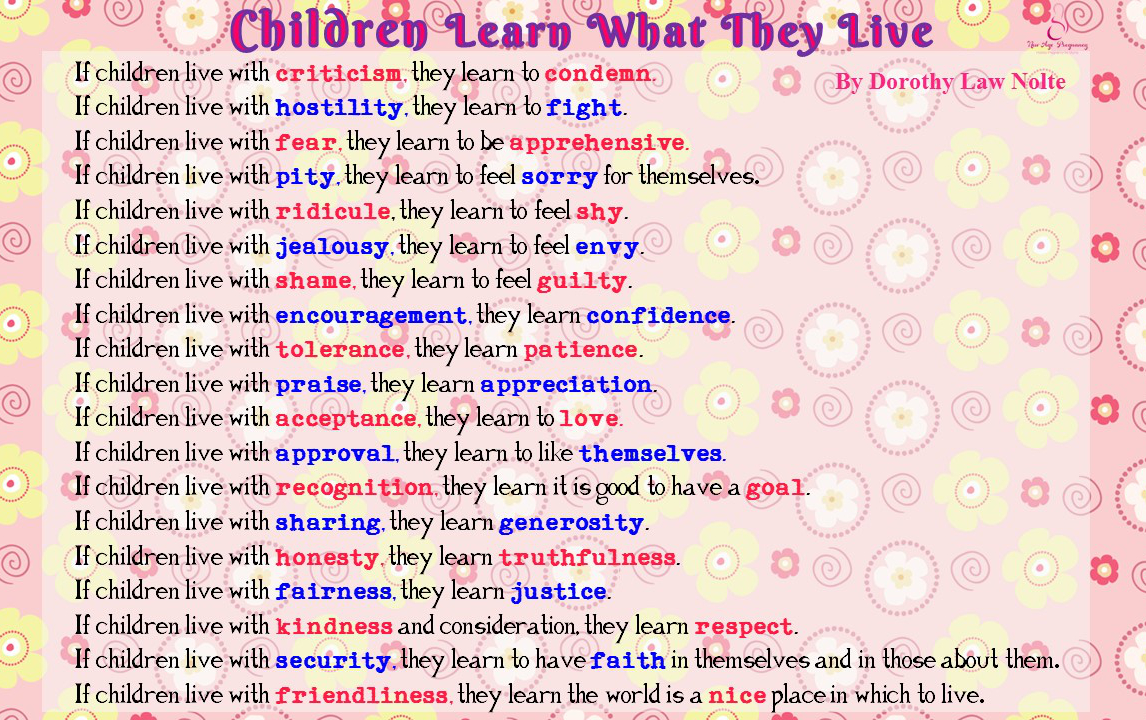
As we explored the areas of growth from prenatal to middle childhood, there are many factors influence a child's biophysical, cognitive, and psychosocial development. Empathy, Attachment, Resilience, Trauma, and Global Child Development all tie in to the profound words of this poem, and the common denominator are the parents/caregivers.  It is our duty to provide a nourishing physical, emotional and social environment for our children to help them reach their fullest potential because anything less is a Travesty. 


If You live with Serenity, your Child will Live with Peace of Mind.

What is Your Child Living? 

References:
https://www.google.com/search?q=dorothy+law+nolte&newwindow=1&biw=1440&bih=785&tbm=isch&tbo=u&source=univ&sa=X&ei=xOjtVJX9GMKnNunggrgE&ved=0CEMQ7Ak#imgdii=_&imgrc=UvLf9TF55glbdM%253A%3ByY_GnQIUG84XyM%3Bhttp%253A%252F%252Fwww.newagepregnancy.com%252Fwp-content%252Fuploads%252F2014%252F12%252Fchildren-learn.jpg%3Bhttp%253A%252F%252Fwww.newagepregnancy.com%252Fchildren-learn-what-they-live%252F%3B1146%3B720

Wednesday, February 11, 2015

Testing for Intelligence
Early experiences are built into our bodies for better or worse. Chronic stressors or "toxic" stressors where children are consistently exposed to harmful environments such as abuse, violence, malnutrition, and neglect have a negative impact on the body and brain. It can lead to health problems like diabetes, high blood pressure and cardiac issues. Unfortunately, these stressors can also contribute to learning disabilities as well. Therefore, it is imperative for parents and caregivers to provide children with an environment free from toxic stressors so they can grow and develop the way their brains and bodies were meant to.
With regards to assessments, I believe, just as children learn differently, they test differently as well. It is important as educators to look at the "whole" child including their culture, family and social lives. Assessments should be diverse and vary in content as well as structure. Not all children test well in standardized pencil and paper tests. Does that mean that they are not intelligent and don't know the information or should be ranked lower than their peers? Educators should strive to integrate tests that give a true picture of the child's knowledge. This can be, for example, in the form of an oral test, because isn't what they know and comprehend what's important? Also, I believe assessments should be worded in ways that children from various cultures are able to understand. For example, if a child who lives in the inner city were asked to name another term for "street," they have probably never heard the word "route" before but a child who lives in Kansas may. For this reason I feel the current assessments used to measure intelligence, promote and graduate students from one grade to the next are unfair. Our society has become so diverse and is acclimating to the many different cultures yet we are still using the same testing techniques that, in my opinion, weren't fair to begin with.
Australia has many of the same assessment criteria as the US but in their curriculum, they include "capabilities" that students need to master as well. An example is cultural where student are taught and encouraged to explore and learn about other cultures in order to gain insight and tolerance for those who are different from them.
When it comes to assessing our children, I feel that multiple assessments are necessary in order to obtain a true picture of what a child truly knows and those assessments should be administered in a variety of settings that are advantageous to the child. This idea holds true when also assessing a child for special needs services. One assessment can't possible give a therapist a true picture of that child's needs. For example, if a child had a bad night and came in for an assessment and was frustrated, angry, and uncooperative, the therapist may not only diagnose that child with lower academic and ability scores but may also diagnose them with behavior problems even though that is not the case. They then waste valuable time placing a child in services that is not addressing their true needs. How are we to help them reach their fullest potential if we don't have a clear picture of what their needs truly are? This leads to many misplacements and misdiagnosis which does not benefit our children and results in larger numbers of students being retained, don’t graduate high school and become less productive adults.
References:
http://www.australiancurriculum.edu.au/generalcapabilities/personal-and-social-capability/introduction/introduction

Center on the Developing Child–Harvard University. (n.d.). InBrief: The science of neglect. [Video file].    http://developingchild.harvard.edu/resources/multimedia/videos/inbrief_series/inbrief_neglect/

Friday, January 30, 2015

Domestic Violence 
My husband’s daughter experienced a violent environment during her young years while living with her biological mother and then emotional stress in her later years.  Her mother has children from different fathers and unfortunately fell into the ugly trap many women do when the relationship does not work out and begins to use the child against the father.  For years, my husband battled for visitation and fought a judicial system that was partial to the mother, no matter the circumstances.  His daughter and siblings were subjected to domestic violence in the home luckily against the mother and not them at the time.  My husband decided to sue for custody and won when she was 7 years old.  When she came to live with us, her mother, maternal grandmother, aunts and friends ridiculed her for the new life she had with us as her language changed and she began to speak correctly.  They constantly reminded her that I was not her mother and she was not to call me mom even though she wanted to. Then after about 2 months, her mother disappeared for almost a year with no communication whatsoever.  The positive that resulted was that my husband’s daughter and I were able to bond and from that built a wonderful relationship over the years.  Unfortunately, one of her siblings got involved in gangs and drugs and was killed several years ago at the age of 21. We believe that had she stayed, she would not be the same beautiful young lady she is today.  We also believe had her sibling’s father been able to get custody of him, he might be alive today.  When my daughter first arrived, we placed her in counseling, made sure she felt a part of our family as we had other children together by this time. She is 19 now and still does not have a good relationship with her maternal side of the family, but it is not because she has not tried or anything we have prevented.  I think she has come a long way and has dealt with rejection well because I have always been here to help fill the void she experienced over the years.
I have always wondered about the widespread abuse in Africa and have learned that it is prevalent in the sub-Saharan region.  More than 40% of the women report regular physical abuse; many are married and suffer verbally and physically from their husbands and in front of their children.  This is a sad situation because what the boys are learning is that it’s ok for the husband to abuse his wife and it’s teaching the girls that this is what you should expect from your husband.  As parent, we need to be cognizant of the impact our actions have on the course of our children’s lives. 

References:
http://www.advocatesforyouth.org/publications/publications-a-z/457-sexual-abuse-and-violence-in-sub-saharan-africa

Thursday, January 15, 2015

Immunization and Public Health Measures

Immunization is said to have had the greatest impact on human mortality reduction and population growth than any other public health intervention aside from clean water.  Immunization protects children from not only temporary sickness but also from complications that arise from disease such as deafness, blindness, sterility or meningitis. Each vaccinated child creates what is called herd immunity because they stop the spread of disease thus protecting others (Berger, 2012)

We must be aware that as our world becomes more connected, diseases know no boundaries and we are putting ourselves and generations to come at risk for widespread disease.
Unfortunately, immunizations cannot yet protect us from AIDS, cholera, malaria, typhoid or shingles and the growing number of missed vaccines because of anxieties can result in reoccurrence of diseases once thought to be under control.  One study also showed that the mortality rate is higher among babies who received 6-8 vaccines in a single doctor visit as opposed to spreading them out. Needless to say, this has had an impact not only on the US but other countries as well. In the mid 1970s, Japan stopped administering the Pertussis (or whooping cough) vaccination because of public concerns over adverse neurological effects. At that point, Japan had brought the disease under control after introducing it in 1947. Pertussis is a highly contagious respiratory disease and one of the leading causes of vaccine-preventable deaths worldwide, causing 300 000 deaths a year, predominantly among unvaccinated or partially vaccinated infants, who go on to suffer vomiting, dehydration and malnutrition. Also, France still has low rates of hepatitis B vaccinations compared with other countries in Europe because it has been rumored that it has been associated with autism, multiple sclerosis and leukemia.
 
This issue is especially meaningful to me because I collaborate with mostly special needs children and families and many of them do not vaccinate their children because they are convinced the vaccinations caused the disability to their child.  I, personally am torn because I have heard the detailed events that occurred to each of these children and I cannot concur with nor negate any possibilities one way or another.  I can only advise my parents of the risks they expose their child to in a public setting when an outbreak occurs that they are not vaccinated for and pray the child does not get sick.  There is so much corruption and secrecy within our country that it wouldn’t surprise me to learn that once again, they are using us as guinea pigs unknowingly.  That’s the conspiracy theorist in me!! Bottom line is that vaccine anxieties impede highly effective public health measures.

References

Berger, K. S. (2012). The developing person through childhood (6th ed.). New York, NY:       Worth Publishers.
http://www2.aap.org/international/immunization/importance.html
http://thinktwice.com/goldman-miller-study.html

http://www.who.int/bulletin/volumes/86/6/08-030608/en/